KG-SSOT
The trust layer for a company brain: knowledge graphs in plain text where a confirmed claim must cite its source, a decision records what it replaced and what it rests on, and a decision comes back for review when a source it pinned changes.
English | Português (Brasil)






Documentation · Adopt it · The contract · Conformance suite · Changelog · For AI agents

The contract in 40 seconds: a claim without a source is refused, then fixed, queried and gated.
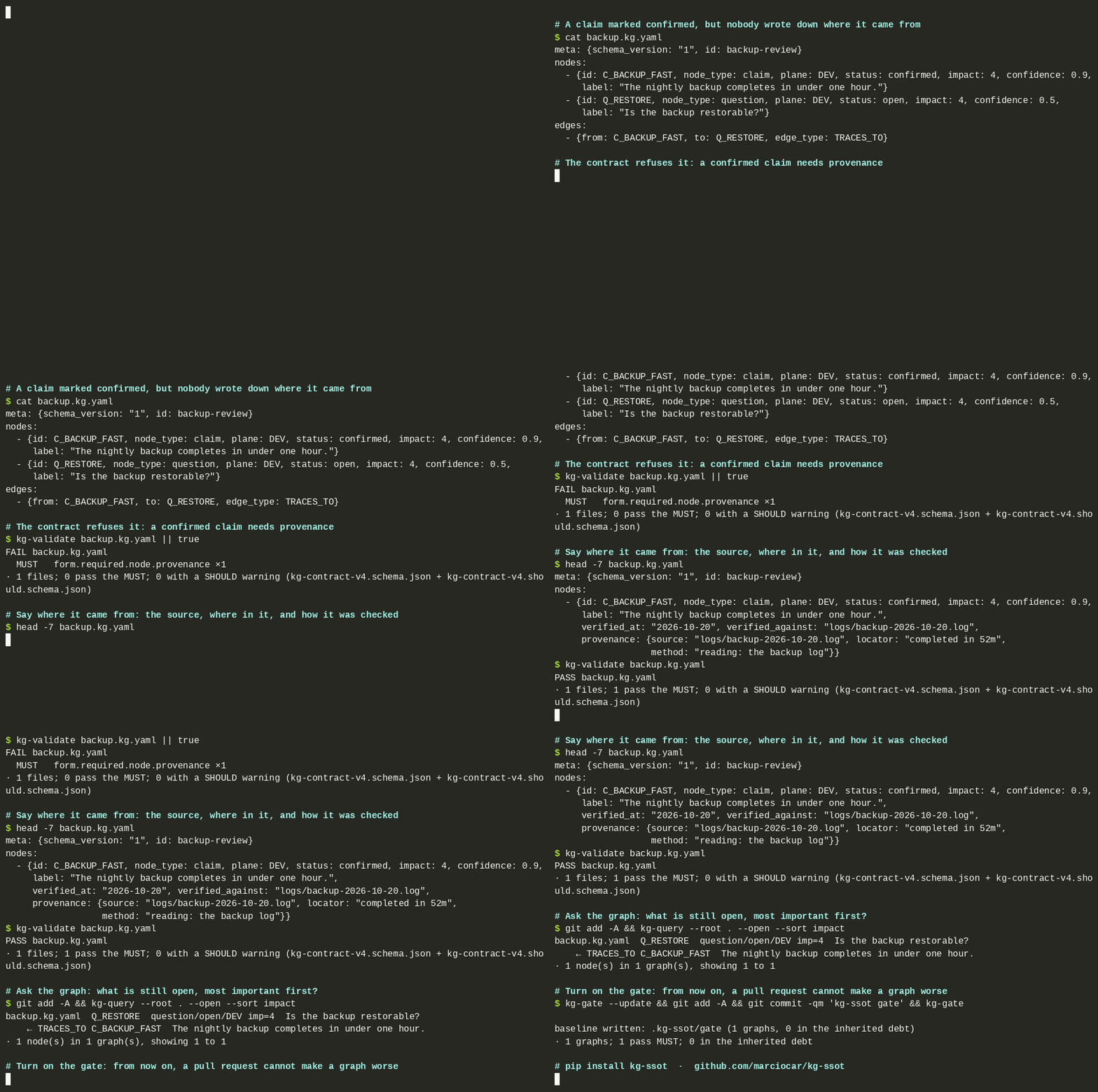
Why
A company brain is usually built by piling documents into RAG or GraphRAG. That keeps the data, but not the decisions: who decided what, on which source, and whether that source still holds. Teams, of people or of agents, pile up conclusions such as "the retry is idempotent" or "we decided on three attempts", and on the way they lose three things: the source, the date it was last verified and what depends on it. When the person who decided leaves, the reasoning leaves too.
KG-SSOT treats this as a format problem, not a discipline problem. Knowledge lives in a .kg.yaml graph,
versioned next to the code, and a formal contract decides in CI what fails:
- a
confirmedor production node without provenance fails (a claim with no recoverable source is declaredunverifiableinstead); - a source that is only a placeholder (
unknown,n/a,tbd) fails; - an edge that points nowhere fails, and so does a node with no edges;
- a verification stamp with nothing to check against, a decision with no origin and a production claim backed only by testimony raise warnings.
What it does for a company brain
| You need to know... | KG-SSOT gives you |
|---|---|
| Where a claim came from | A provenance on every confirmed claim: the file, the line or the node, and, if you pin it, a hash that kg_trace.py check verifies |
| Why a decision was made, and what it replaced | kg_query --decision ID: the whole SUPERSEDES line, what supports it and the status of each support |
| Which decisions to look at again | kg_query --revisit: the ones past their review cadence, contested, or whose approved document or pinned source changed |
| What is on each owner's plate | kg_query --open --where owner=X --sort attention |
| How many open decisions each graph holds, or any count by field | kg_query --type decision --open --group-by file |
| Which nodes are most supported, and by how many distinct sources | kg_query --edges --where edge_type=SUPPORTS --group-by to.file --group-by to.id --count-distinct from.id |
Which decisions have no internal SUPPORTS edge in their own graph |
kg_query --type decision --where degree.in.SUPPORTS=0; a SUPPORTS from another graph is not counted, so complete it with kg_query --edges --where edge_type=SUPPORTS --where scope=external |
| What is past its re-verification date, on any kind of node | kg_query --due, the most overdue first |
| Who cites this node in other repositories, before you delete it | kg_refs cited-by repo:ID --repo name=folder ..., with what was and was not read |
| What an e-mail, chat or wiki event said, and who sent it | An evidence node with the CloudEvents 1.0.2 names in x_event, pinned to the accepted inbox document (recipe) |
Business, technical, compliance and design knowledge can live in the same format, in your repository. It plugs in
as a Python package or an MCP server, with a JavaScript validator on npm, and the CI gate is one of its uses, not the
point. The pins are checked when kg_query or kg_trace.py runs with --root.
Get started in 60 seconds
pip install kg-ssot

# the conformance suite against the reference reader, from the installed package
kg-conformance | tail -2

# one valid graph and one that fails
kg-validate valid.kg.yaml broken.kg.yaml
Or straight from the repository, with hash-checked dependencies:
git clone https://github.com/marciocar/kg-ssot && cd kg-ssot
python3 -m venv .venv && .venv/bin/pip install --require-hashes -r tools/requirements.txt
.venv/bin/python3 -I tools/kg_validate.py \
  spec/conformance/fixtures/latest/form/minimal/valid-minimal.kg.yaml \
  spec/conformance/fixtures/latest/form/minimal/bad-node-missing-label.kg.yaml
PASS spec/conformance/fixtures/latest/form/minimal/valid-minimal.kg.yaml
FAIL spec/conformance/fixtures/latest/form/minimal/bad-node-missing-label.kg.yaml
  MUST   form.required.node.label ×1
· 2 files; 1 pass the MUST; 0 with a SHOULD warning (kg-contract-v4.schema.json + kg-contract-v4.should.schema.json)
The tools print in English by default and in Brazilian Portuguese when your locale is pt_BR (or
KG_SSOT_LANG=pt-BR). Codes, exit codes and JSON keys never change with the language; only the human text does.
Install
| Channel | Command | What you get |
|---|---|---|
| PyPI | pip install kg-ssot |
The commands kg-validate, kg-conformance, kg-gate, kg-store, kg-query, kg-diff, kg-vocab, kg-criterion, kg-audit, kg-trace, kg-refs, kg-vector, kg-mcp and kg-prov-export, with the contract and the suite inside; pip install "kg-ssot[vector]" adds the search by similarity |
| npm | npm install kg-ssot |
The JavaScript reader with a precompiled validator, which also runs in React Native and Expo |
| Claude Desktop | the .mcpb file from the latest release |
The MCP server as a one-click extension |
| MCP Registry | io.github.marciocar/kg-ssot |
The same server for any MCP client |
| Container | docker pull ghcr.io/marciocar/kg-ssot |
The MCP server as a service next to a client without Python, such as LibreChat |
| Your repository | kg_vendor.py update --tag kg-ssot-v4.45.0 |
The release vendored by tag, with a sha256 stamp, and the gate in your CI (manual, chapter 6) |
A node, inside
- id: C_RETRY_SAFE
  node_type: claim
  plane: PROD
  status: confirmed
  impact: 4
  confidence: 0.8
  label: The payment retry is idempotent.
  verified_at: "2026-10-01"
  verified_against: tests/payment_retry_test.py
  provenance:
    source: tests/payment_retry_test.py
    locator: test_retry_is_idempotent
    method: "measurement: integration test in CI"
The label is the claim, short. The provenance says where it came from and how: one of five method classes,
measurement, reading, judges, derived or testimony. The stamp says when it was verified and against what.
Since contract v4.16 these English names are the canonical form; the Portuguese medição, leitura, juízes,
derivado and testemunho are still accepted as aliases, with no warning.
Use it from an AI agent
The reference MCP server gives a model the contract and a store: it validates a graph, writes only what passes, reads, lists, queries with every edge resolved to the label on the other end, and shows history. Read-only tools are annotated as such, so a client can skip confirmation for them.
kg_schema_help returns the current contract, a minimal passing example and the fixes for the most common codes, so a
model can write a passing graph on the first try. llms.txt indexes the documentation for agents, and
llms-full.txt has all of it in one file.
The agent skill. skills/kg-ssot/ is an Agent Skills skill that teaches a coding agent
to write, fix, validate and query graphs with these tools, in .kg.yaml and .kg.json. In a pre-registered test, an
agent with the skill reached the same result with 45% of the output tokens and 54% of the tool calls.
npx skills add marciocar/kg-ssot -s kg-ssot # Claude Code, Codex and other clients that read Agent Skills
In Claude Code, it also comes as a plugin: /plugin marketplace add marciocar/kg-ssot, then
/plugin install kg-ssot@kg-ssot.
How it works
flowchart LR
  subgraph product["Product (one tag kg-ssot-vX.Y.Z)"]
    C["Contract<br/>JSON Schema MUST + SHOULD<br/>+ integrity rules"]
    S["Conformance suite<br/>512 cases as plain data"]
    R["Reference reader<br/>kg_validate.py"]
    S -- "every reader passes" --> R
    C --> R
  end
  subgraph adopter["Adopter repository"]
    V["vendor/kg-ssot<br/>+ sha256 stamp"]
    G["kg_gate.py in CI<br/>per-graph ratchet"]
    K["the team's .kg.yaml"]
    V --> G
    K --> G
  end
  product -- "kg_vendor.py update --tag" --> V
G -- "nothing gets worse:<br/>a new graph passes,<br/>debt only shrinks" --> PR["PR approved"]- The contract is JSON Schema 2020-12 at two levels: MUST fails, SHOULD warns. The rules a schema cannot express (unique ids, existing edge ends, orphan nodes) are part of it.
- The suite is the compatibility proof: each case is a real YAML file with the expected verdict and codes, and a reader passes only if it emits exactly the same codes.
- The kit brings the contract to a repository by tag, with a stamp that fails local edits, and runs the per-graph ratchet in CI: what already failed becomes named debt, a new graph has to pass, and the debt only shrinks.
Features
| Two-level contract | MUST fails, SHOULD warns, with a ramp: what warns in one version can fail in the next, and the adopter sees it coming |
| Structured provenance | source, locator and method, with five evidence classes and the source locality (repo, web, host, pessoa, privado) |
| Verification stamp | verified_at and verified_against, with a warning for a stamp with no target and for a verification dated before the fact |
| Edges between graphs | external_edges, with the far end checked against the corpus |
| Stable codes | Every violation has a code such as form.required.node.provenance, and --where names the node |
| Structured verdict | kg_validate.py --format json returns the verdict with code, document path, line, message and fix hint, in a versioned format (spec/verdict.schema.json) for tools and MCP servers |
| Two formats, one model | .kg.yaml to write and review in a diff, and .kg.json for runtime use (an app, a server), read by a JSON parser under the contract's JSON profile (RFC 8259, I-JSON, up to 128 levels, unique keys) |
| Gated store | kg_store.py writes .kg.yaml or .kg.json to disk, a git repository or a versioned store, only after the contract passes, with external edges checked in the store and optimistic locking for concurrent writers |
| Reference MCP server | kg_mcp.py serves the contract and the store over MCP (stdio, or HTTP behind a proxy with per-identity areas), with tool annotations |
| Query and diff | kg_query.py selects nodes across a whole corpus and projects every edge with the label on the other end, paginated (kg-ssot.query/1); kg_diff.py compares revisions by id, field by field, reading git without a checkout (kg-ssot.diff/1) |
| Domain vocabulary | The x_term profile gives each synonym its source, document version and verification date; kg_vocab.py resolves a text to its term, lists what is due, and exports to SKOS-XL and Apache Ossie (kg-ssot.vocab/1); the MCP server serves it as kg_terms. Since 4.23 a short code gets a readable name in its scheme (notation and scheme), and kg_vocab.py lint checks the codes in prose, with a ratchet |
| Pre-registered criterion | x_criterion gives each version of a yardstick a node and a sha256, and x_measured_under ties a result to the version it was measured under; changing the yardstick after seeing the data shows up as a post-hoc warning, and kg_criterion.py checks the sha256 against the text or the file (kg-ssot.criterion/1) |
| The trace that resolves | kg_trace.py check --root . checks each node's trace: anchor against the files of the repository (integrity.trace-target-missing, kg-ssot.trace/1), and counts apart what it does not judge |
| Citations across repositories | kg_refs.py answers who cites a node before you delete it, and what changed in what you cite, over a declared list of local clones. A query, not an alarm: a change never alters the exit code, and an empty answer from a partial scan says so (kg-ssot.refs/1). It finds a wrong citation, not a missing one |
| Search by meaning | kg_query.py --text <term> --semantic "<question>" finds the node when the question uses other words, fusing the text search and a local multilingual embedding model by RRF; optional (kg-ssot[vector]), pinned by sha256, and outside every verdict |
| Audit package by question | kg_audit.py exports one row per questionnaire item (the x_questionnaire profile), with the question, the answer, the verdict, the required and the given evidence with its date and due date, the evidence requests (role: evidence_request and evidence_requirement), the contradictions, the owner, and the gaps it computes, in CSV, XLSX (no dependency), or JSON (kg-ssot.audit/1) |
| Data-only suite | 512 cases with their own metaschema, in the style of the JSON-Schema-Test-Suite |
| Per-graph ratchet | Adopt without a big-bang migration: inherited debt stays named and only shrinks |
| Vendor by tag | No copy-paste, no shared code: one sha256 stamp per file |
| Profile-driven migrator | kg_migrate.py proposes the provenance the contract asks for, from rules the adopter declares, shows the plan first and writes with node-by-node invariance |
| PROV-O bridge | kg_prov_export.py exports each node's provenance as prov:Entity and prov:Derivation in JSON-LD, for the W3C PROV ecosystem; --edges adds the edges, with cito:supports, cito:refutes and dcterms:replaces where a standard term exists |
| No platform | Python 3.12 or later, PyYAML and jsonschema, installed with checked hashes (--require-hashes). No server, editor or assistant required |
What KG-SSOT is not
| If you need... | ...use something else | What KG-SSOT gives you |
|---|---|---|
| A query language over a large graph | A graph database | A file format and a contract, with no server |
| Semantic web interoperability | RDF, OWL, SHACL | A small, closed YAML vocabulary that reads well in a diff, and a PROV-O export |
| Enterprise search over documents | A search platform | No connectors or index: only the graph the team writes |
| Retrieval over document chunks (RAG, GraphRAG) | A vector store or a GraphRAG tool | The claims those documents make, the decisions taken on them, and what to revisit |
| A guarantee that a claim is true | Human review, tests | The guarantee that it says where it came from and when it was verified |
Status
- Current: contract v4, release
kg-ssot-v4.45.0. The reference reader passes 512 of 512 cases inlatest/. - In use: three adopters run the gate in CI, one of them in production.
- Next: v5 will fail a
methodoutside the<class>: <detail>form, which only warns today. - Open: the semantic layer (freshness, contradiction, domain completeness) lives in
optional/, and the reference reader does not implement it: it passes only the 10 valid cases there.
Documentation
| Manual | Concepts, format, contract, tools, recipes and troubleshooting |
| ADOPTING.md | The complete adoption guide, with every edge case |
| The contract | Contract v4: the two levels, the codes and what changes between versions |
| spec/conformance/ | The suite format, the codes and how to measure a reader in another language |
| CHANGELOG.md | Every release, newest first |
| llms.txt · llms-full.txt | For AI agents: the index with links, and the whole documentation in one file |
Contributing
A contract change starts with a conformance case: the .kg.yaml that shows the behavior and the expected verdict.
Releases are tags kg-ssot-vX.Y.Z of the development repository, where every pull request that touches spec/ or
tools/ runs the suite and the kit tests in CI. The release mirror holds only what each tag ships, one commit per
tag, and does not take pull requests: a proposal or a bug goes in as an
issue, ideally with the case that shows it. A reader in another
language is welcome: chapter 7 of the manual explains how to measure it.
License
The product (what the release ships, listed in spec/release.json: the contract, the suite, the
.kg.yaml cases, the kit in tools/, ADOPTING.md, this README and the manual) is Apache-2.0:
LICENSE, with the scope in NOTICE.
KG-SSOT was born inside the Onion framework, which now adopts it by tag like any other adopter. The product does not depend on it.